
There is a phrase that gets tossed around a lot once you hit your thirties and realize your social circle is never going to look like a perfectly cast nineties sitcom. That phrase is “keeping it civil.” I was grabbing my iced Tesora this morning, staring out at the traffic, and thinking about how bizarre adult social dynamics have become. We use the word “cordial” like it’s a magic spell that instantly neutralizes awkwardness. It is the ultimate peace treaty of the modern millennial friend group the bare minimum standard you agree to when you just want to go to a mutual friend’s wedding or a backyard barbecue without turning the evening into a Bravo reunion special.
But over the last few years, I have realized something baffling: a terrifying number of grown adults have absolutely no idea what being civil actually means. Some people treat the concept of cordiality like it’s a loophole, a strategic gray area where they can still act out their weird, unresolved high school complexes while technically claiming they “aren’t doing anything.” So today on Stories from Tina, we are going to clear the air. We are going to establish the official, undisputed baseline of what being civil actually entails, what it absolutely does not, and where we draw the hard line between keeping the peace and just being undeniably sneaky.
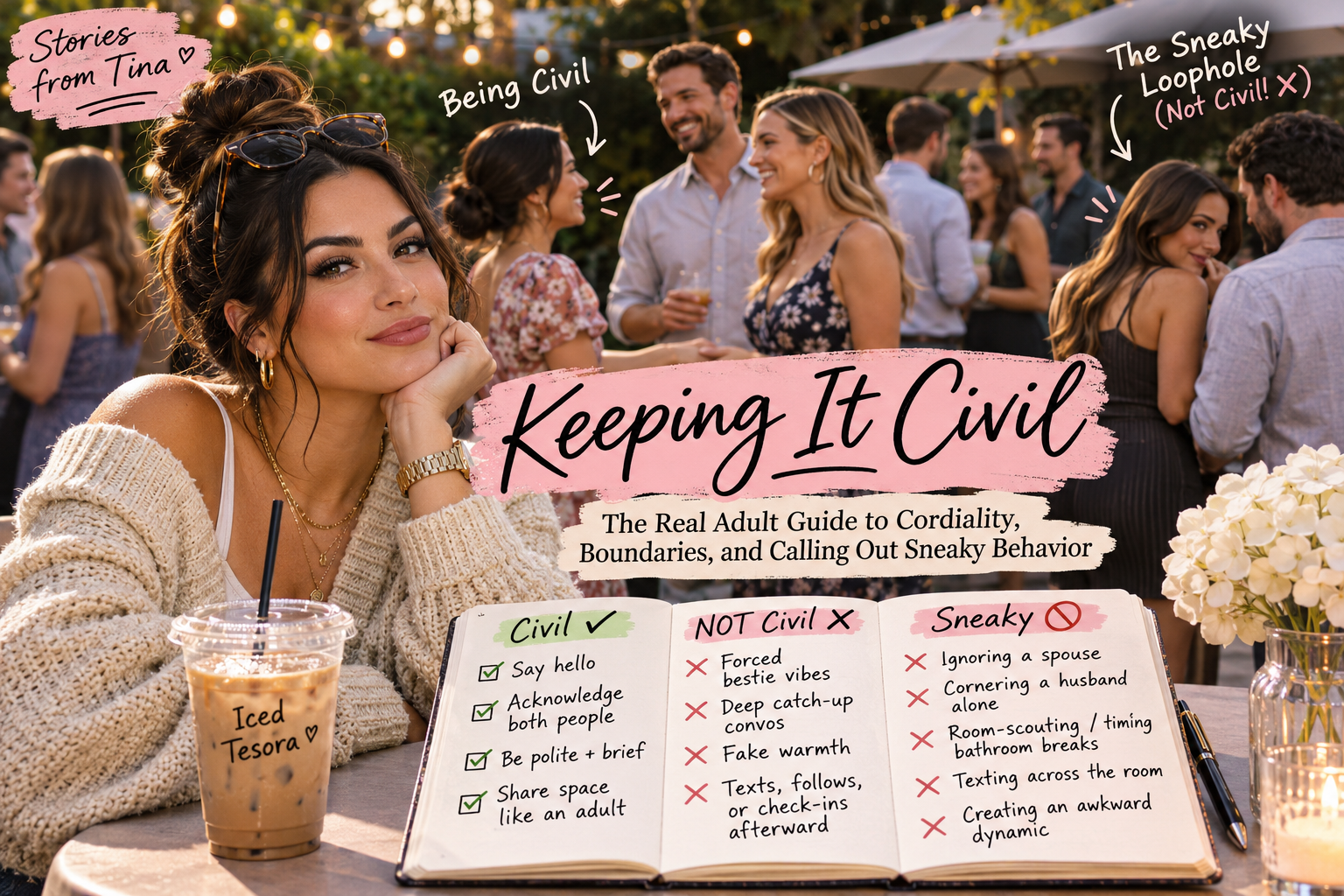
Let’s start with the basics, the things we should have all mastered by the time we got our driver’s licenses. Being civil is incredibly straightforward. It means you walk into a room, you acknowledge the people standing in it, and you say hello. That is it. It means if we are standing next to each other at the appetizer table, we can successfully pass the napkins without catching on fire. It means making eye contact, using a polite tone of voice, and functioning in a shared space like fully formed adults.
If you bump into a married couple, being cordial means you look at both of them, you offer a standard greeting, and you move on with your life. It is the social equivalent of elevator music: it’s bland, it’s entirely surface-level, and it exists simply to make the ride comfortable for everyone else in the building. When you agree to be civil for the sake of the friend group, you are agreeing to put your ego aside for three hours so the host doesn’t have to play UN peacekeeper. You treat the person the exact same way you would treat a coworker from a different department respectful, brief, and transparent.
Now, let’s talk about the relief of boundaries. Being civil does not mean we are suddenly best friends. It does not mean we need to force a deep, thirty-minute catch-up conversation about our hopes, dreams, and childhood traumas. I do not expect you to ask me how my microbiology classes are going, and you do not have to pretend to care about my dogs.
Cordiality does not require a fake smile plastered on your face all night, and it definitely does not mean we are exchanging text messages the next day. You don’t have to follow me on Instagram, you don’t have to like my posts, and you don’t have to send me a Christmas card. There is zero expectation of warmth or intimacy.
In fact, the beauty of truly keeping things civil is that it requires almost zero emotional currency. You do not have to “fake it.” You do not have to pretend to be overjoyed to see someone. You just have to be polite, and then you get to walk away. It is actually the most liberating dynamic in the world once you accept it, because it removes all the pressure of performance.
This is where the grown-up Mean Girls always get it twisted. Because they operate on a need for control, they think “being civil” means they can just ignore your existence entirely while still trying to monopolize the people they do want to talk to.
Let me make this crystal clear: scoping out a room to see if a wife has stepped away to grab a drink just so you can sprint over and corner her husband alone is not “being civil.” That is playing a frantic, bizarre game of emotional espionage. Pretending a spouse is just a temporary, annoying roadblock standing in the way of you reliving your glory days with their partner is not keeping the peace. It is glaringly obvious, it is deeply uncomfortable for everyone watching, and frankly, it gives off massive amounts of sneaky energy.
What does “sneaky” actually look like in practice? It is the calculated blind spot. It is walking into a room and suddenly finding the ceiling architecture absolutely fascinating just to avoid making eye contact with me. It is physically placing three mutual friends between us at a dinner table like a human barricade. It is texting a husband from across the room to get his attention instead of just walking up to the couple and speaking out loud. Sneaky is waiting in the wings like a stagehand in a high school play, timing your social interactions purely around my bathroom breaks.
You cannot claim you are “just trying to keep things cordial” when you are actively refusing to accept that married couples are a package deal. A good friend even an estranged one knows that you cannot be truly respectful to someone if you are simultaneously trying to bypass and ice out their spouse. It is a delusion to think that if you just wait until the wife goes to the restroom, the marriage temporarily ceases to exist and you can have the husband all to yourself.
What this behavior actually does is force the husband into a deeply awkward position. Husbands do not find this flattering. They find it weird. It gives them the “ick” to stand there while someone blatantly disrespects their wife by playing an elaborate game of hide-and-seek. It also makes the mutual friends sweat through their shirts watching the dynamic, because everyone in the room has eyes. Everyone sees the room-scouting. Everyone notices the deliberate pivot away from the couple. And it completely shatters whatever “peace” you claimed you were trying to keep.
When you finally call out this weird, covert-ops behavior, they never just own it. Instead, they whip out a Rolodex of perfectly crafted excuses, weaponizing the very concept of “keeping the peace” to justify their bad manners.
“I just didn’t see her!” Please. We are in a twelve-by-twelve living room, I am wearing bright colors, and you have 20/20 vision. You saw me; you just didn’t want to deal with the reality of me being there.
“I was just giving them space.” No, you are treating me like a biohazard quarantine zone. Giving someone space means stepping back gracefully. It doesn’t mean dodging behind a charcuterie board the second I walk into the kitchen.
“I just didn’t want to cause any drama.” This is the biggest lie of all. By actively acting like a Cold War spy, dodging eye contact, and pulling husbands into corners, you are the drama. You are the one making the air thick with tension. A simple “hello” diffuses the drama; an elaborate avoidance routine amplifies it.
They use these excuses because it allows them to play the victim. They rebrand their rudeness as “being cautious” or “respecting boundaries,” hoping the mutual friends will pat them on the back for being so mature. But in reality, it is just a socially acceptable cover for holding a petty, one-sided grudge.
At thirty-three, balancing a demanding career, college finals, and a whole family, my tolerance for social acrobatics is sitting firmly at zero. I don’t have the time, the energy, or the desire to decode someone’s passive-aggressive room-scouting behavior.
The most empowering thing you can do when someone weaponizes the concept of “being civil” is to hold them to the actual, literal definition of the word. You don’t have to get angry, you don’t have to send a long paragraph, and you don’t have to create a scene. You just have to look at them, entirely unbothered, and expect basic manners.
If they can’t manage to walk up to a married couple, say a polite hello to both people, and go about their evening if that is simply too high of a bar for them to clear then the problem was never the conflict. The problem is their sheer inability to act their age.
Protect your peace, set the standard, and never let anyone convince you that expecting basic, transparent respect is asking for too much. Let them play their avoidance games while you sit back, sip your coffee, and enjoy the actual party. The view is always better when you refuse to lower your bar.
A very interesting and relatable take on adult relationships! I completely agree that being civil doesn’t mean pretending to be friends or forcing intimacy. It simply means showing basic respect, maintaining healthy boundaries, and allowing everyone to enjoy a shared space without unnecessary drama. True maturity is knowing that we don’t have to like everyone, but we should still treat people with dignity. Sometimes, a polite hello and graceful distance are all that peace requires! 😊