
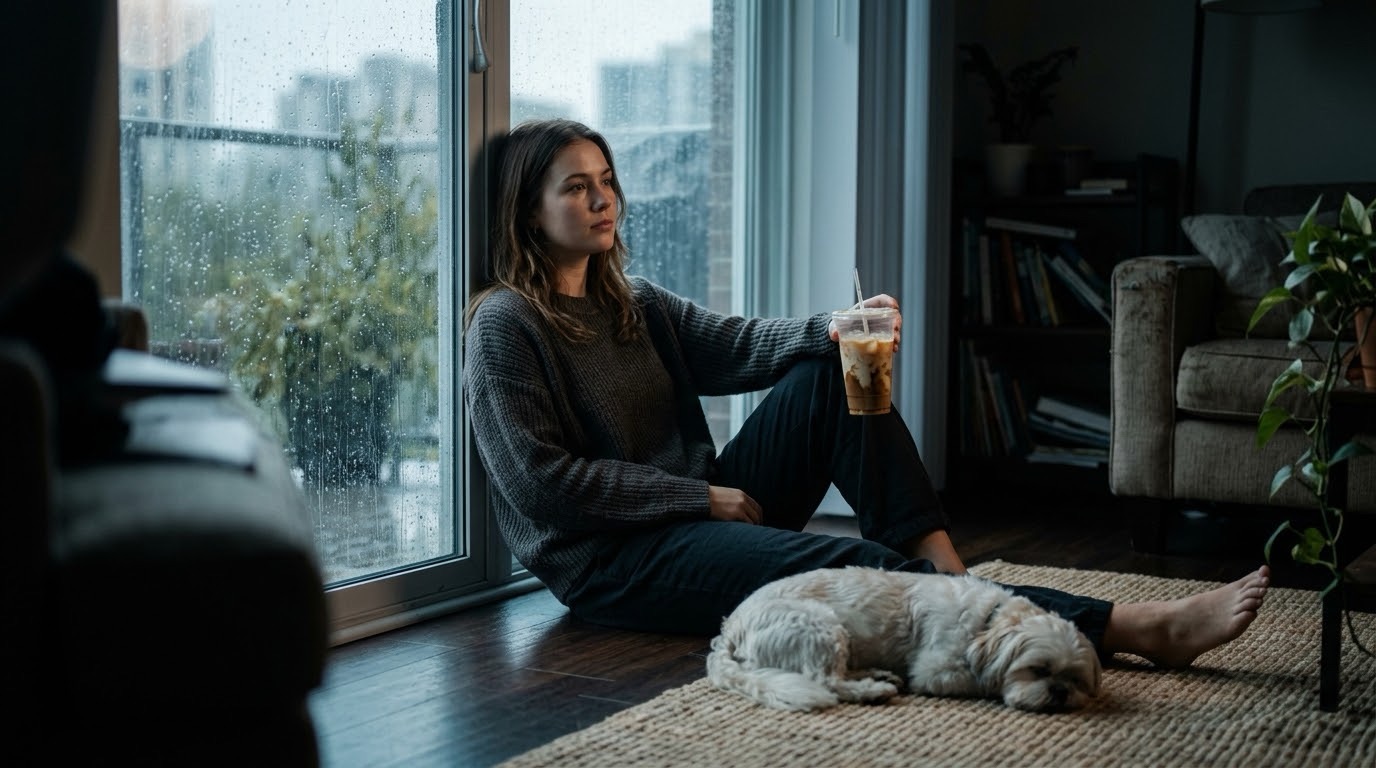
Grab your iced Tesora; make it a large with heavy cream and sweet flavor today, guys, because we’re skipping the usual lighthearted stuff. Normally, you’d find me on here venting about wrangling Noah and Maureen, or laughing at Daisy snoring on the rug while I try to put my life together. But as I sit here today, looking out the window, my mind keeps drifting to a heavy, suffocating place.
I’ve been feeling the profound need to think outside the box and look at the things we usually keep locked in the darkest, quietest corners of our minds. The things we only admit when we are crying on the bathroom floor at 2:00 AM, praying nobody hears us.
I have to warn you right now: today’s post is raw. It is going to hurt. If you cannot handle uncomfortable truths about sexual trauma, this is your cue to click away. But for those staying whether you’re a Gen Z student navigating a hyper-digital world where everything is seen but you feel entirely invisible, a millennial just trying to keep a marriage and a career afloat while silently drowning in your own mind, or someone from an older generation who has carried a crushing, silent burden for decades simply because “we just didn’t talk about it back then” we need to have a real conversation. We need to talk about the brutal reality of sexual assault, the permanent scars it leaves on your soul, and the darkest, most agonizing question that haunts almost every victim: Why me?
When you have been stripped of your bodily autonomy, when someone has reached in and violently taken your choice, it is incredibly common to look around at the world and feel a toxic, burning mix of anger and confusion. It is an ugly, deeply human response. A lot of victims look at women in the adult industry OnlyFans creators, porn stars, escorts and think a thought that fills them with instant shame: Why couldn’t it happen to them? They’re choosing to be in that environment. They’re choosing to put their bodies out there. Why is it always the people who never asked for it who get abused and raped time after time?
It feels entirely unfair. It’s a taboo thought, but let’s finally unpack it in the light.
Society loves to cling to the comfortable narrative that women in the adult industry are all broken, traumatized victims of childhood abuse who were easy prey. It makes the world feel neat. It makes people feel safe. But the reality? Credible surveys show they are remarkably similar to other women, except they often just enjoy sex more. They like the flexible hours, the money, the control.
When you realize that many of these women are out there making millions entirely on their own terms, while a victim of assault is living in a daily, waking nightmare they never consented to, the unfairness is absolutely suffocating. If a woman can choose to have highly explicit sex on camera, command a room, and walk away feeling empowered and rich, why does the random girl who just wanted to walk home safely from a party keep getting hunted? Why does the little boy who just wanted to trust his coach end up broken? It feels like the universe is intentionally skipping over the people who opted into a boundary-light world, only to drop the absolute worst horrors onto the quiet ones who just wanted an ordinary life.
If you have ever had that angry, bitter, jealous thought, I need you to hear me right now: you are not a bad person. You are not evil. You are just utterly exhausted by the sheer unfairness of it all. When you feel that flash of anger toward a sexually liberated woman, you aren’t actually wishing harm on her. You are grieving your own stolen autonomy. You are mourning the ghost of the person you were supposed to be. You are grieving the fact that someone else gets to freely, joyfully choose what happens to their body, while you feel like a permanent hostage inside yours.
The damage from sexual violence is never just a bad memory. It is a complete, violent rewiring of the human experience. When you look at how the nervous system actually works, you realize that the biological response to trauma is absolute chaos.
In the short term, the brain’s immediate reaction isn’t usually the dramatic fight-or-flight we see in the movies. It is the freeze. When faced with an imminent, terrifying threat, the brain literally instructs the body to shut down to survive. It pulls the plug. It’s hardwired into our DNA. Yet, victims carry the agonizing, soul-crushing guilt of “Why didn’t I scream? Why didn’t I fight back?” for the rest of their lives. Add to that the immediate shock, the emotional numbness, the complete detachment, and you have a person who is entirely disconnected from their own reality.
Let me say this loudly for the person in the back who needs to hear it: Not fighting is not consenting. Freezing is not consenting. Survival is not consent. Your brain did exactly what it had to do to keep your heart beating.
But the long-term effects? That’s where the real haunting begins. Internally, the brain’s circuitries get completely fried. The alarm bell in your head gets jammed in the “ON” position. The systems that regulate your sleep and your appetite overlap with the systems that process trauma. That is why survivors often battle brutal, tear-soaked insomnia, or sleep for fourteen hours a day just to escape the consciousness of their own skin. You might be standing in your kitchen doing something as normal and safe as chopping vegetables for a pot of okra soup, and suddenly, a specific smell hits the air. A shadow moves a certain way. Instantly, your heart rate spikes to 150 beats per minute. You drop the knife. You can’t breathe. Your logical brain knows you are safe in your own home, but your body is screaming, thrashing, convinced that you are back in the absolute worst moment of your life.
This chronic stress fundamentally destroys your immune system. Survivors are plagued by chronic pain that doctors can’t explain, debilitating migraines that leave them in dark rooms, and severe stomach issues. Your nervous system is constantly humming at a baseline of “red alert,” flooding your veins with cortisol until your body is completely, fundamentally exhausted. You are tired in your bones. You are tired in your soul.
When the physical bruises fade, the psychological haunting takes over, and it manifests in ways that outsiders will never understand.
It looks like dissociation: feeling completely detached from your own body, like you’re watching a movie of your life playing out from the corner of the ceiling. You hear your friends talking, you see your children smiling, but everything feels a million miles away, submerged underwater.
It looks like high-functioning depression and anxiety. It’s not always staying in bed crying. Sometimes, depression looks like the funniest, brightest person in the room. It’s the person who goes to work, excels at their job, pays the bills, makes a beautiful dinner for their family, laughs at the jokes, and then goes into the bathroom, turns on the shower so nobody can hear, and collapses into silent, shaking sobs because they feel entirely empty inside. Anxiety turns your beautiful mind into an unpaid, exhausted security guard—always checking the exits, always mapping the room, always wondering why that stranger is standing a little too close, always calculating the fastest way to survive.
It looks like a desperate search for control. When your ultimate control was violently ripped from your hands, obsessively organizing your living room, controlling every single calorie that enters your mouth, or bingeing until you feel sick just to numb the sharp edges of your anxiety feels like a desperate attempt to grab the steering wheel of a crashing car.
Trauma steals your emotional regulation. If you’ve ever wondered why a survivor might go from zero to a hundred, screaming and crying over a misplaced set of keys, it’s because their distress tolerance has been completely decimated. The cup is already overflowing; the keys were just the final drop.
This creates a terrifying dynamic in our social lives and romantic relationships. You become hyper-vigilant. If someone loves you gently, your broken brain whispers, What’s the catch? What do they want from me? When are they going to turn into a monster? Survivors often engage in brutal, heartbreaking self-sabotage. They will lash out at the absolute safest people in their lives. I know when I am stressed, Mo gets the brunt of it. Why? Because the anxiety of waiting for the other shoe to drop is physical torture. It feels safer to detonate the bridge yourself, on your own terms, than to walk across it and wait in terror for someone else to cut the ropes. Are you going to hurt me like the others? Let’s find out right now.
Alternatively, some survivors go the opposite route and become chronic, terrified people pleasers. If keeping an abuser happy was your childhood survival tactic, saying “no” as an adult feels like looking down the barrel of a gun. You apologize for breathing. You avoid confrontation at all costs. You tolerate behavior that makes you physically sick and miserable, just to keep the peace, because your body believes that conflict equals death.
We absolutely have to talk about how this pain manifests differently across demographics, because the societal prisons we build for survivors affect everyone, and they are all suffocating.
To the women reading this: The aftermath is a constant, degrading trial by public opinion. You are interrogated about what you drank, the length of your dress, how many people you’ve slept with, and why you didn’t scream louder. You are simultaneously treated like a fragile, broken, contaminated thing, and yet somehow painted as a criminal mastermind who is entirely responsible for the violent actions of a grown man. The shame eats you alive until you are trying to shrink yourself to take up less space in the world.
To the men and boys reading this: I see your silent, crushing agony. The silence imposed on you is deafening. We live in a culture that still peddles the toxic, garbage lie that men are always supposed to be the conquerors, the strong ones, the aggressors who “always want it.” When a man or a young boy is assaulted, society either laughs it off as a “lucky break” or violently strips them of their masculinity. You are suffocated by the terror that if you admit you were overpowered and victimized, your very identity as a man will be questioned. So, you bury it. You bury it deep under layers of explosive anger, alcohol, drugs, and dangerous adrenaline-seeking behaviors, crying in the dark where no one can ever see you.
To the older generations: I am so sorry for the decades you spent carrying this alone. The culture of “sweep it under the rug” and “we keep family secrets” forced you to smile through holidays sitting across from the people who destroyed you. Your pain was buried for the sake of everyone else’s comfort, and you deserved so much better.
To the new generation: You have the vocabulary for mental health, but you are living in a hyper-digital world where everything is exposed, and yet you have never felt more isolated. You are navigating a hookup culture that constantly blurs the lines of consent, leaving you dizzy, traumatized, and wondering if you are just “too sensitive.” You are not. Your boundaries matter.
And then there is the cruelest, most vicious statistic of all. Being sexually assaulted actually puts you at a significantly higher risk of being assaulted again. Why? Because abuse teaches you silence.
If you are abused young, your boundaries are demolished before the foundation is even poured. You are trained by monsters to associate affection with trauma. Abusers are incredibly, terrifyingly skilled at smelling that vulnerability in a crowded room. They use a toxic mix of affection, isolation, and shame to trap victims in a cycle that makes the victim believe they are the broken puzzle piece causing all the pain.
We don’t blame a homeowner for getting their house robbed twice, but society constantly interrogates a woman or a man who has been assaulted more than once. Why do you keep putting yourself in those situations? The stigma forces victims to internalize the blame, leading to severe depression, self-harm, and suicidal thoughts because they genuinely believe they are fundamentally defective.
Whenever sexual assault becomes a public conversation, why does so much attention immediately shift toward the person who was attacked? We will investigate a victim’s social media from a decade ago, analyze their relationship status, and practically request a copy of their kindergarten report card to prove they were a “perfect” victim. Meanwhile, asking why a human being actively chose to ignore another person’s consent becomes a secondary, hushed conversation.
Make it make sense.
Perpetrators are not one single personality type. Yes, they can be strangers hiding in an alley. But far more often, they are spouses. They are best friends. They are authority figures, coaches, youth pastors, and deeply respected members of a community. Society loves the idea that dangerous people are easy to recognize—we desperately want the monster to look like a monster so we can avoid him. But sometimes the person who causes the most irreversible harm is also the person everybody else praises.
They rationalize their horrific behavior: “She was flirting. He didn’t say no. We’re married. I was drunk. It wasn’t a big deal.” Let’s be crystal clear right now: claiming confusion does not automatically erase your accountability. Previous sexual contact never, ever guarantees present consent. A person does not acquire permanent ownership over someone else’s body because of affection, money, a wedding ring, or social status.
Society has deeply romanticized healing. We love the shiny before-and-after story where the person struggles, goes to a few therapy sessions, finds their soulmate, forgives everybody who ruined their life, and smiles in a field of sunflowers like a walking inspirational quote.
That is beautiful. But real healing isn’t that neat. Real healing is incredibly messy.
Healing is making six months of progress and then experiencing a massive, panic-inducing setback because you smelled a certain brand of cologne in the grocery store. Healing is realizing you absolutely do not have to forgive someone to recover. Let me repeat that: Forgiveness is a personal choice, not a mandatory toll you have to pay to get your life back. You are allowed to leave them in the past, entirely unforgiven, and still find your own peace.
If you love a survivor, understand that supporting them doesn’t mean having every perfect answer. Sometimes it means just sitting with them in the dark, holding their hand, and listening without judgment. Sometimes it means honoring their boundaries when they flinch. And if you are a partner, remember that you cannot love somebody’s trauma away. You cannot fix them. But you can help create an environment of profound safety where they can finally lay their armor down and heal themselves.
To the person reading this right now with tears in your eyes, the one who feels angry at the world, who resents people with “easy” lives, who feels completely singled out by suffering: I see you. I see the invisible backpack of rocks you carry every single day. Your brain’s reaction the freezing, the dissociation, the anger, the pushing people away was not a weakness. It was your magnificent, beautiful body doing whatever it took to keep you alive.
Nobody else’s body should ever become the substitute for yours. Not the woman who works in the adult industry, not the man who is afraid to disclose his abuse, not anybody. Changing who gets hurt is not justice. Preventing the harm from happening in the first place is.
You did not choose this. You did not ask for this. And you never, ever deserved it. Healing isn’t a straight line; it’s a brutal, winding, exhausting road. But please, give yourself the grace that this cruel world refused to give you. Life can be overwhelmingly painful, but meaningful relationships, true autonomy, and genuine, breathless joy remain possible for you. Not because the past disappears it won’t but because you deserve a future that contains so much more than the harm that was done to you.
Before you go, let’s have an open conversation.
I know today’s blog was much heavier than usual, and I know it might have brought up things you’ve tried hard to bury. But I want us to think, and I want us to feel less alone. Have you ever experienced something so unfair that you found yourself resenting people who seemed to have the life you wanted? Do you think society actually understands how deeply sexual trauma affects our emotional reactions and our ability to love?
You don’t have to share your personal experiences publicly. Please, protect your peace first and foremost. But know that if you are carrying these memories, if you are reading this and crying because someone finally put it into words, you are allowed to be human. You don’t have to turn your trauma into a TED Talk. You just have to survive it, and eventually, learn to live again.
Until next time, my loves, protect your peace, violently respect other people’s boundaries, and remember that somebody else’s freedom is not responsible for the pain another person caused you.
With love, a lot of uncomfortable honesty, and an extra-large cup of coffee,
Tina ❤️
Stories From Tina: Where real life, uncomfortable conversations, a little humor, and the truth all come together.